The global payments landscape is undergoing a profound shift. For financial institutions, the question is no longer whether to modernize—but how to do so in a way that strengthens competitive advantage, accelerates innovation, and reduces long‑term operational risk.
The answer lies not in sweeping, high‑risk overhauls but in a strategic, phased approach to migration that positions institutions to lead with confidence.
Today’s payments ecosystem operates at the intersection of consumer expectation, regulatory evolution, and relentless technological progress. Legacy systems—built decades ago for a card‑centric world—can no longer keep pace with the reinvention required for real‑time, omnichannel, digitally native payments. Financial institutions that continue to rely solely on these platforms risk falling behind those that embrace evolution as a continuous discipline rather than a one‑time initiative.
Why Modernization Is Now a Strategic Imperative
Modernization is no longer a technology exercise—it is a strategic mandate tied directly to growth, customer engagement, and competitive differentiation. Consumers today expect payments to be fast, digital, secure, and available everywhere. They also expect institutions to seamlessly support new forms of value exchange—whether instant payments, digital wallets, Request to Pay, or emerging non‑card journeys. Institutions built on aging architecture face rising costs, performance bottlenecks, and an inability to adapt quickly—conditions that ultimately suppress innovation and hinder long‑term relevance.
Forward‑thinking leaders recognize that the cost of inaction now outweighs the risk of transformation. The market—and the customer—is moving with or without them.
Phased Migration: The Leadership Approach to Sustainable Innovation
Where traditional "big bang" migrations often fail under the weight of complexity, a phased strategy introduces structure, stability, and measurable value at every step.
A phased approach allows new, cloud‑native services to be deployed alongside existing systems. This gives institutions the freedom to innovate rapidly while minimizing operational disruption. It also enables leaders to build internal momentum—demonstrating early wins, strengthening stakeholder alignment, and building modernization muscle within the organization.
Phased migration is more than an execution model; it is a mindset shift. It turns modernization into an iterative capability that grows over time instead of a single transformational moment.
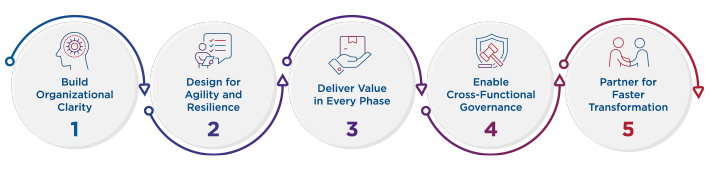 How Payments Leaders Chart a Confident Modernization Journey
1. Start with Deep Organizational Clarity.
How Payments Leaders Chart a Confident Modernization Journey
1. Start with Deep Organizational Clarity. Thought‑leadership begins with understanding. Leading institutions begin by building a clear inventory of their payments ecosystem—platforms, rails, products, volumes, performance gaps, and future demands. This step illuminates where modernization will yield the highest strategic return.
2. Prioritize Agility and Resilience Over Perfection. In a world of accelerating change, the goal is not to build a system for the next decade, but a system that can evolve with the next decade. Modern platforms thrive on adaptability—API‑first design, cloud‑native architecture, real‑time processing, and modular services.
3. Unlock Value in Every Phase. Effective leaders don’t wait until the end of a multi‑year program to see value. They design each phase to deliver business‑ready capabilities—new services, improved efficiency, better compliance posture, or enhanced customer experiences.
4. Establish Governance That Enables, Not Restricts. Modernization thrives when organizational silos dissolve. Payments, technology, operations, risk, and customer experience teams must collaborate early and often. Strong governance becomes a strategic enabler—not a bottleneck.
5. Choose Partners That Accelerate Transformation. The right technology partners bring more than software—they bring modernization frameworks, accelerators, and proven migration experience. Leaders select partners who can support a long‑term vision, not just a single project milestone.
The Competitive Edge of Modern Payments Infrastructure
Institutions that embrace phased modernization position themselves to:
- Launch new payment types faster and more confidently
- Reduce the operational burden and cost of legacy silos
- Meet and exceed evolving regulatory expectations
- Leverage data across channels for deeper customer insight
- Support real‑time, cloud‑native, scalable innovation
The future belongs to organizations willing to modernize with discipline, foresight, and adaptability. As payments become increasingly central to customer relationships, this transformation becomes not just an IT priority but a strategic differentiator.
A New Era of Payments Leadership
Payments modernization is not merely a technology upgrade—it is leadership in action. It signals to the market, to customers, and to internal teams that the institution is ready to win in a more dynamic, more competitive, and more digitally driven financial ecosystem.
With a phased approach, institutions don’t simply catch up with the future—they shape it.
Contact us today to learn more.


