Across major retail industry gatherings and in ongoing conversations with executives, one theme consistently rises to the surface: AI is no longer defined by hype — it’s defined by what works on the store floor and how AI improves retail store operations in real time.
This evolution isn’t theoretical. It’s happening because retailers continue to operate under intense pressure: thin margins, labor constraints, and increasingly complex store environments. When technology requires heavy integration, introduces friction, or fails to perform reliably in live settings, the cost is immediate.
A recent industry study reinforces this reality: more than 70% of retailers lose at least 5% of operating margin due to in‑store inefficiencies
1 highlighting the need for AI solutions that reduce shrink and improve store efficiency. For many organizations, the question is no longer whether AI matters — it’s how to apply it in ways that directly reduce these inefficiencies and support already‑overburdened store teams.
In past years, industry conversations around AI often centered on bold predictions or distant possibilities. Today, that narrative has matured. Retailers are no longer evaluating AI on conceptual use cases or demo‑only capabilities — they’re asking a much more practical question: How does this make store operations better tomorrow?
The most meaningful applications of AI share a common thread: they improve the customer and associate experience at the point where friction is felt most. This includes areas such as product recognition and item accuracy; loss prevention and shrink reduction; checkout flow and intervention minimization; and operational efficiency and staff enablement.
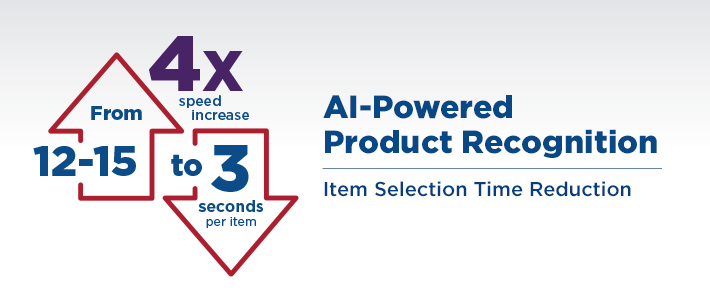
These aren’t abstract concepts. They translate into tangible outcomes. Research shows that AI‑powered product recognition can reduce item selection time from 12–15 seconds to just 3 seconds per item, enabling checkouts
up to four times faster, demonstrating how AI reduces checkout errors. Speed matters — but so does reliability. When an AI system can consistently identify products, minimize false interventions, and allow associates to step out of ‘problem solver’ mode, it drives a smoother customer journey and increases throughput without adding labor.
Retailers aren’t excited about AI itself. They’re excited about fewer errors, less manual correction, faster lanes, and more time for associates to focus on value‑added interactions. That is the real shift in the market.
This pragmatic shift toward results also extends to how retailers think about data. Most retailers are not data‑poor. If anything, they’re swimming in more information than they can operationalize — from cameras and sensors to POS systems, loyalty data, workforce tools, and more.
The question has become: How do we turn data into real‑time, in‑store intelligence? At Diebold Nixdorf,
our perspective is straightforward: AI, analytics, and store systems only matter when they work together to deliver immediate, actionable insights at scale.
This means leveraging existing data streams — not creating entirely new ones; ensuring AI models are trained for the reality of live retail environments; supporting front‑line teams through automation that feels intuitive, not intrusive; and delivering intelligence that reduces shrink, increases accuracy, and keeps lanes moving.
One strong example of this mindset in action comes from Groupement Mousquetaires in France. After deploying an AI‑powered shrink reduction solution, the retailer saw
erroneous transactions drop from approximately 3% to less than 1%, demonstrating the real‑world value for reducing shrink with AI in retail.
Results like that are what retailers are increasingly prioritizing: not AI that promises transformation in five years, but AI that measurably improves operational performance right now.
As conversations across the industry continue to evolve, a few patterns have become clear:
- AI must fit into the store, not the other way around. Technology that requires heavy retraining, rewiring, or complex new workflows rarely lands well. Practical AI respects store rhythms.
- Retailers value accuracy over ambition. Reducing false positives, minimizing interventions, and ensuring reliable performance are more important than showcasing cutting‑edge capabilities.
- Data must be actionable, not just accessible. The most effective solutions convert existing data into intelligence that associates can use in the moment.
- Proven outcomes matter more than theoretical ROI. Retailers want evidence: fewer errors, reduced shrink, faster lines, fewer touchpoints, and better customer experiences.
- Scalability is the new differentiator. A pilot that works in one store isn’t enough. Retailers want solutions that can perform consistently across thousands of stores, formats, and edge conditions.
Industry events, leadership forums, and retailer roundtables will continue to showcase new technologies — and AI will remain front and center. But the lens has fundamentally changed.
Retailers are no longer chasing AI as a possibility. They’re evaluating it as a proven operational tool.
At Diebold Nixdorf, we believe intelligent retail requires a fusion of hardware, software, and AI that respects store environments, enhances associate capability, and delivers impact at scale. Innovation only matters when it improves the daily realities of retail operations — reducing friction, increasing accuracy, and freeing up teams to focus on what they do best: serving customers.
The future of AI in retail won’t be defined by hype cycles or theoretical roadmaps. It will be defined by execution — and by solutions that consistently show up for retailers where it matters most: inside the store, in real time, at scale.
Talk to a Diebold Nixdorf expert today to learn more about AI for your retail store operations.
Sources:
1 The Packer
 HANDEL


