For grocery retailers across North America, peak season no longer tests the store once a year. It tests the front end every month. Checkout is where continuous peak becomes visible first, not in annual forecasts, or in quarterly reports, but at the lane.
When transaction intensity compresses into narrow windows, throughput, uptime, and front-end responsiveness are tested quickly. Flow becomes uneven. Associates shift from service to troubleshooting. Seconds begin to stack.
This is what continuous peak looks like in practice. Demand no longer rises above a steady baseline and disappears. It returns before systems have time to reset, and the front end is where true readiness is revealed.
The Drivers of Continuous Peak
Continuous peak does not first show itself in forecasts or planning cycles. As outlined in
Rethink Retail’s Intelligent Retail Playbook, it becomes visible at checkout, where compressed demand reveals whether systems, staffing, and flow are built for repetition.
Benefit distribution cycles, including SNAP and EBT, paycheck cycles, value-driven shopping behavior, viral product demand, and regional weather events compress transaction volume into recurring, high-intensity windows. For many households living paycheck to paycheck, limited flexibility for off-cycle visits makes these windows even more concentrated. These windows overlap. They return quickly. They leave little time for operational recovery.
Peak is no longer a seasonal spike, but a sustained operating condition.
In the United States, billions of dollars in SNAP benefits flow through grocery retailers each month, with spending heavily concentrated immediately after issuance. For stores serving a high proportion of benefit recipients, this creates predictable transaction surges that resemble holiday-level demand — every month. Across North America, that same pattern is reinforced by paycheck cycles, value sensitivity, and household cash-flow constraints that can limit shopper flexibility outside planned purchase windows. Layered onto that cadence are moment-driven disruptions that peak quickly and compress demand into narrow timeframes, often with little advance notice.
The result is not simply higher volume, but repeated compression of demand, and when transaction intensity rises within tight windows, front-end environments absorb the impact first.
Labor schedules, store layouts, and retail POS systems are typically built around average flow. Under continuous peak conditions, averages become less relevant. Stability depends on how well systems perform under repeated stress.
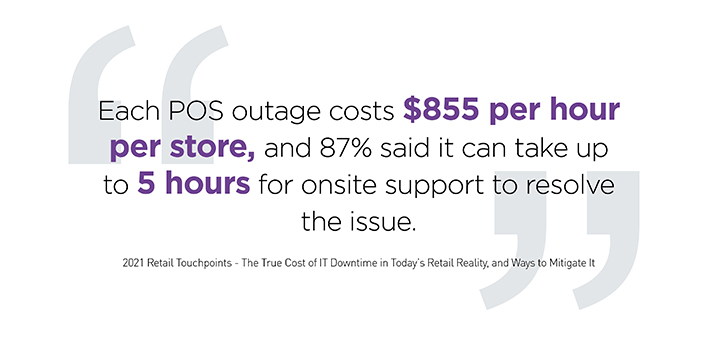
Pressure rarely builds through catastrophic failure. It accumulates quietly, behind the scenes, and appears in ways such as:
- Brief reductions in system responsiveness or lane availability
- Associates pulled into reactive troubleshooting, exception handling, or repeated overrides
Individually, these interruptions appear minor. At scale, they compound.
Continuous peak exposes fragility faster than traditional seasonal surges because it offers little reset time and doesn’t allow systems to fully recover before the next demand cycle begins.
Designing for Stability Under Repeated Demand
Peak-ready grocers approach this reality differently. Rather than treating peak as an isolated event to manage, they design front-end operations to remain steady under variability.
Several characteristics define this approach, as retailers shift the focus from maximizing throughput during occasional spikes to preserving flow stability across recurring cycles.
- Transaction flow remains balanced across attended lanes and self-service checkout machines, preventing congestion from concentrating in one channel.
- The checkout mix is aligned to how demand actually compresses in the store, not how it performs on an average Tuesday afternoon.
- Retail POS systems and self-service checkout environments are optimized for reliability, uptime, and throughput under high-frequency transaction pressure.
- Uptime is treated as a core performance indicator, not an IT metric in the background.
- Every avoided system degradation preserves transaction rhythm.
As a result of these optimizations, manual intervention is minimized. In this model, resilience is less about operating faster and more about operating steadily. The objective is to absorb pressure quietly, so it never escalates into visible breakdown.
Continuous peak in grocery is unlikely to recede; benefit cycles will continue, value sensitivity will remain elevated, and demand will stay compressed and behavior driven.
For grocery retailers across North America, the question is no longer whether peak will occur. It is whether store infrastructure, POS solutions, staffing alignment, and front-end design are built to sustain it repeatedly without degradation.
Readiness, adaptability, and uptime are no longer enhancements reserved for Q4; they are the baseline.
Is your front end built for continuous peak demand?
Download our report to see how retail managed services improve uptime, flow and checkout performance.
 HANDEL


